Introduction
Last week I had the privilege of attending Umbraco Spark at We the Curious in Bristol. This was my first Spark, and only my second Umbraco event I had been to. What follows isn't a roundup. It's something more personal.
Before going through the day’s events, I wanted to talk about bubbles. We all have them, whether our friendship groups, our work circles, our family or even just the local community where we live. I live and work from a small town in Lincolnshire, which means my bubble is small. I have always been fascinated by computers. My earliest memory is playing Space Cadet Pinball a few days after Christmas in 1996. There was something about it that just clicked. The idea that a machine could do that, could create something interactive and alive on a screen, got into my head and never really left. That curiosity is what eventually led me into software development. It felt less like a career choice and more like a natural conclusion.

The Slow Erosion
What nobody tells you about a career is that the same thing that drew you in can quietly start to fade. For me it did not happen overnight. It was gradual. The curiosity that used to pull me toward a problem started to feel more like an obligation. I was still doing good work, still showing up, but the energy behind it had shifted. This wasn’t a feeling of burnout. It felt less like exhaustion and more like rust. My passion for software development slowly eroding away.
In addition to this, moving to live and work remotely in Lincolnshire created a little bubble. There is no office conversation for me, no chance encounter with a colleague talking about something that sparks a new thought. No breaking up of the routine.
So, when the invite to Spark came up, I said yes, partly out of obligation, partly out of something quieter that still wanted to be curious.
Bristol - The night before Spark
I could tell I was stepping out of my bubble before the event had even started. After a 3 hour drive down to Bristol I was standing at a bus stop at 11pm, waiting for the Park and Ride to take me to my hotel. I genuinely began to question my ability to be a functioning adult. It had been so long since I had used public transport that the whole thing felt oddly daunting. That moment stuck with me though, discomfort is usually a sign that change is happening, at least for me that is.
Umbraco Spark 2026
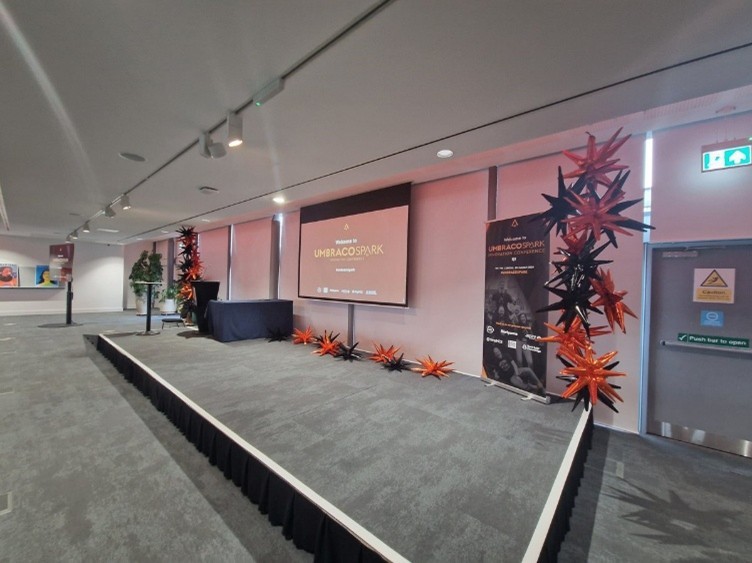
Walking into We the Curious the next morning, I did not quite know what to expect. At CodeGarden 2025, I had a colleague with me as moral support. Being an early bird I arrived before the room started to fill. I remembered my boss reiterating to me earlier in the week when I asked what the business’s expectation was for me at the event and it was to “Just go there and have fun”.


The event is described as: “Umbraco Spark focuses on technical, innovation and developer-focused topics and is dedicated to bringing together developers for a day of learning and inspiration”.
But it felt so much more than just that.
Swag bag at hand I watched as the room filled with people and chatter. As I eavesdropped, I found a room of people that cared about the same things I used to care about without reservation. Developers, designers, and people at every stage of their careers, all there because they genuinely wanted to be.
The Line Up
The format of the day was neatly printed on our lanyards as a handy reminder. There was a 45-minute talk between each break with some 10-minute talks to take us through to the next break. Whether the talk was 45minutes or 10 minutes I found all of them informative and engaging.

What better way to developer’s hearts than to kick the day off with code. That really set the tone for me. I thoroughly enjoyed and was engaged with Kenn Jacobsen's talk on Umbraco Search and the different ways it can be used. Umbraco Search is not something I had much experience with, so it was a good learning exercise to see its potential.
The next talk was from Rachel Breeze MBCS on whether to Stay, Upgrade or Rewrite a website. With the recent launch of Umbraco 17 last year, the Backoffice changes introduced in Umbraco 14 and many clients on sites using 13 or older it couldn’t have come at a better time. I recently had worked on a proposal at work which involved this very decision, and I wish I had seen this talk. Sometimes you need to take a step back and evaluate the whole picture and that choosing not to upgrade is just a valid decision as choosing to rewrite or rebuild. The key takeaway is ownership and acceptance of risk.
Arguably one of the talks that sat with me for the rest of the day and the inspiration behind this reflective blogpost was by Joe Glombek. This was one of the smaller 10min talks but its impact was big. His talk about community and the benefits of attending or engaging with it holds true how I felt before and after the event. Those attending conferences, meetups, hackathons - whether online or in person - really does break up the day-to-day grind. It can give a sense of purpose, it can educate. It really provides space for you to not only grow your professional skills but your personal ones too.
If you have 20 minutes to spare do feel free to watch an extended version of his talk: https://joe.gl/ombek/talks/developers-assemble/
The official talks ended with Niels Lyngsø from Umbraco showing off some upcoming features in the Backoffice. There is a caveat here that things are still in development and some of what was presented was with wireframes and subject to change. I really liked the idea of shared content using Elements and what that means not only for content editors but for developers too. I’m watching this space and excited to see what comes next.
I also liked how there is a conscious choice by the team to create a visual language to keep things clear on what is shared / linked content and what is not using various colours and icons. Niels and I had a great chat after about the potential of the feature as well as a general discussion about solving problems in development and that what people think they want verse what solves the problem. That really stayed with me.
The Package Awards

It was here where I thought the day was done (this was my first Spark remember), there was going to be a short award ceremony and then we would be on our merry old way. Little did I know that this would be the highlight of my whole experience. Until this point I never really had the confidence to attend a hackathon / package jam. I always thought “There's no way I can build something in a day” .
Seeing all the different packages a room full of developers can build in a day by sharing ideas, knowledge within a friendly atmosphere, I was a little awestruck. What struck me most across all of it was how freely people shared. Not just knowledge, but enthusiasm. Nobody was performing interest. They just had it.
The After Party
I had a bit of time to spare before the clock ran out on my parking. Feeling invigorated from the day and a part of me not wanting it to end I stepped out my comfort zone again and walked across the public space to the Ritorno Lounge. It’s here where I met a few more people within the industry. Notably Ravi Motha, whom I only had a brief introduction at CodeGarden 2025. It was great to talk to him about the London Meetup and how I can get involved.
I also had an interesting discussion with Kas. I. from Cogworks around AI, job security, potential and what the future looks like personally and professionally. Unfortunately, I was limited on time and I genuinely didn’t want it to end but alas I had a bus to catch, this time feeling more confident.
The Spark, a reflection on the day

Each talk built on the last. Each conversation added something. It was not one big moment but a gradual accumulation, like the day slowly getting lighter without you being able to pinpoint exactly when it stopped being dark.
That said, there was one moment that has stayed with me. Being in a room full of people who already knew each other, who had their circles and their in-jokes and their histories, was more daunting than I expected. I hovered on the edges of a few groups, doing that thing where you look purposefully at your phone so you seem occupied rather than lost. Then I spotted someone sitting at a bench with enough space beside them and a smile that made it clear the space was genuinely open. That was all it took. I sat down, said hello, and had one of the best conversations of the day around life, career and experiences.
It sounds almost embarrassingly simple. But sometimes the smallest signal of openness is the only thing standing between someone staying in their shell and connecting.
Talking to people who loved this community reminded me why I got into software development it in the first place. That 1996 kid sitting in front of a screen thinking "how does this work" had not gone anywhere. He had just been very quiet for a while.
The bus ride back was different to the one the night before. I had notes in my phone, a few new connections, and for the first time in longer than I care to admit, I was thinking about code because I wanted to, not because I had to.
If you are feeling it too...
I cannot reiterate how going to events and being amongst the community can be.
If there is one piece of advice for businesses or managers is don’t put expectations or pressures on developers that go to these events. Let them enjoy the day! Or in my boss’s words, “Just go there and have fun”.
If any of this sounds familiar, I would just say this: get outside your bubble, even a little. It does not have to be a conference. It could be a meetup, a forum, a conversation, engaging on the Discord channel. The isolation that modern world creates is real and it compounds quietly.
Community is not a cure for burnout, but it is a reminder that your enthusiasm was never really gone.
Sometimes it just needs somewhere to land.
I am glad I got on that bus.